

Steel Strip Cutting Machine: Engineering Precision in Modern Metal Processing
Manufacturing efficiency often hinges on a single overlooked capability: the ability to transform wide master coils into narrow, production-ready strips without sacrificing dimensional accuracy or material integrity. For steel service centers, automotive suppliers, and metal distributors, this transformation determines whether raw material becomes valuable inventory or scrap. The steel strip cutting machine addresses this fundamental need by performing longitudinal slitting operations that separate broad coils into multiple narrower widths, each held to tolerances measured in hundredths of a millimeter.
Metal processors encounter a persistent challenge when master coils arrive from mills in standardized widths but downstream manufacturing requires dozens of different strip dimensions. Manual cutting methods introduce variation, waste edge material, and consume labor hours that erode profit margins. A properly configured slitting machine line automates this conversion, maintaining constant tension across the material web while rotary cutters divide the sheet into precise strips that feed directly into tube mills, roll forming lines, or stamping operations.
Core Mechanical Architecture
The foundation of any steel strip cutting machine rests on three interconnected subsystems: decoiling, slitting, and recoiling. Each subsystem must synchronize with the others to maintain consistent web tension and prevent material deformation during processing.
Decoiling mechanisms support master coils ranging from 2.5 metric tons to 35 metric tons, with mandrel diameters accommodating industry-standard core sizes including 508 mm and 610 mm. Hydraulic expansion systems grip the coil interior while motorized rotation feeds material into the line at controlled speeds. Entry pinch rollers stabilize the leading edge and establish initial tension values that cascade through the entire system.
Between decoiling and slitting, leveling units remove residual coil set—the curvature inherent in rolled material. Multiple work rolls apply alternating bending forces that yield the metal surface just enough to relieve internal stress without reducing sheet thickness. This step proves critical when processing high-strength steel grades or pre-painted materials where surface damage must be avoided.
The slitting station itself houses precision arbors fitted with circular rotary knives positioned in male-female pairs. Each knife set creates a shearing action that separates the material cleanly along the desired line. Tooling changeover systems allow operators to reposition knives for different strip widths, with modern designs completing adjustments in under thirty minutes. Scrap choppers or balers collect edge trimmings and skeletal waste, compacting material for efficient recycling.
Material Compatibility Across Alloy Families
Steel strip cutting machines process a broader material spectrum than the name suggests. Carbon steel in thicknesses from 0.1 mm to 25 mm represents the primary workload, but stainless alloys, aluminum, copper, and pre-painted substrates all pass through these lines with appropriate tooling adjustments.
Stainless steel demands carbide or coated tool steel knives because the alloy’s work-hardening behavior dulls conventional blades rapidly. Feed rates typically decrease by 30 to 40 percent compared to mild steel to preserve edge quality and extend tool life. Aluminum and copper, being softer and more ductile, require sharper knife angles and meticulous tension control to prevent edge burrs and material stretching.
Pre-painted or coated materials introduce an additional constraint: the coating must not chip, flake, or delaminate during slitting. This requires knife geometry that cuts the substrate cleanly while the coating fractures along the cut line without propagating cracks into adjacent areas. Operators adjust knife overlap—the depth one blade penetrates past the material plane toward its mating blade—to optimize cut quality for each coating type.
| Material Type | Thickness Range | Typical Line Speed | Primary Tooling Consideration |
|---|---|---|---|
| Mild Steel | 0.3–12.0 mm | 80–120 m/min | Standard HSS or carbide knives |
| Stainless Steel | 0.5–6.0 mm | 40–80 m/min | Coated carbide, reduced overlap |
| Aluminum | 0.2–8.0 mm | 60–100 m/min | Sharp blade angles, low tension |
| Pre-Painted Steel | 0.4–2.5 mm | 50–90 m/min | Minimal overlap, polymer-safe geometry |
| Copper | 0.3–5.0 mm | 50–80 m/min | Frequent blade cleaning, anti-oxidation |
Precision Control and Automation Integration
Dimensional accuracy separates industrial slitting lines from simpler rotary cutters. Strip width tolerances of ±0.05 mm to ±0.5 mm mean that a 100 mm wide strip cannot vary by more than half a millimeter across an entire coil length, which may extend several hundred meters. Achieving this consistency requires closed-loop control systems that monitor and adjust multiple parameters in real time.
Computer-controlled systems manage line speed, tension zones, and knife positioning through programmable logic controllers networked with servo drives and hydraulic actuators. Operators input target strip widths and material specifications through touchscreen interfaces, and the system calculates optimal tension profiles, leveling roller gaps, and recoiler torque curves automatically. This eliminates the trial-and-error approach that once characterized setup procedures.
Diagnostic subsystems continuously monitor vibration signatures, hydraulic pressures, and motor loads. Anomalies trigger alerts before they escalate into quality defects or equipment damage. For instance, a gradual increase in slitter arbor vibration indicates knife wear, prompting a scheduled tool change rather than an unplanned production halt.
Automatic coil feeding systems use threading tables and pinch rollers to guide the material through the line without manual intervention. When one master coil depletes, the system can be configured to pause, allowing an operator to weld the trailing edge of the exhausted coil to the leading edge of a new coil, enabling semi-continuous operation that maximizes throughput.
Application Contexts and Operational Logic
Steel service centers represent the largest user base for slitting machines. These facilities stock master coils in a limited range of widths and thicknesses, then slit them to order based on customer specifications. A single 1500 mm wide coil might yield ten 100 mm strips for a tube mill, fifteen 80 mm strips for a garage door manufacturer, and one 300 mm strip for a stamping operation—all from the same master.
Automotive suppliers rely on slitting lines to prepare high-strength steel strips for structural components like door beams and roof rails. These applications demand not only dimensional precision but also edge quality free from microcracks that could initiate fatigue failures. Slitting machines equipped with advanced knife geometries and post-cut edge inspection systems meet these stringent requirements.
Roll forming operations consume vast quantities of narrow strip. Whether producing metal framing studs, cable trays, or HVAC ductwork, roll form mills require consistent strip width to prevent jamming in the forming stands. Integrating a slitting line upstream allows manufacturers to purchase economical wide coils and generate their own feedstock, reducing per-pound material costs and lead times.
The decision to invest in a slitting machine line hinges on several operational factors:
- Coil volume and diversity: Facilities processing more than 500 tons per month across multiple strip widths typically achieve payback within two years through reduced material waste and labor savings.
- Tolerance requirements: Applications demanding ±0.1 mm or tighter necessitate high-precision tooling and leveling systems that increase capital costs but deliver the required accuracy.
- Material variety: Operations handling multiple alloy families benefit from quick-change tooling and programmable control systems that store setup parameters for each material type.
- Floor space and power: Standard slitting lines occupy 8 to 36 meters in length and require 45 to 285 kW of installed power, factors that influence facility layout and electrical infrastructure.
Operational Efficiency and Throughput Metrics
Line speed, measured in meters per minute, directly impacts productivity but must be balanced against material behavior and quality constraints. Mild steel strips in the 0.5 to 3.0 mm thickness range commonly slit at 80 to 120 m/min, translating to substantial hourly output when multiplied by the number of simultaneous strips—often eight to thirty-two depending on target widths.
Thicker materials and harder alloys reduce achievable speeds. A 12 mm carbon steel coil might process at 40 m/min, while a 1.5 mm stainless coil runs at 60 m/min. These speed reductions reflect the increased cutting forces and heat generation that thick or hard materials impose on the tooling.
Setup time between jobs represents a hidden productivity factor. Traditional slitting lines required two to four hours to reposition knives and adjust tension systems for a new strip pattern. Modern quick-change arbors and stored setup programs compress this interval to thirty to sixty minutes, allowing facilities to process smaller lot sizes economically.
Edge quality assessment has moved beyond visual inspection. Automated optical systems scan slit edges at line speed, detecting burrs, fractures, and dimensional variations in real time. Reject material is flagged and segregated, preventing defective strips from entering inventory.
Maintenance Considerations and Tool Life
Slitting knives endure immense mechanical and thermal stress. Each rotation subjects the cutting edge to compressive and shearing forces that plastically deform the tool material at the microscopic level. Over time, this deformation manifests as edge rounding, which increases cutting force and degrades edge quality.
Tool life varies widely based on material type and thickness. Mild steel coils may yield several hundred hours of cutting before requiring knife replacement, while stainless steel typically reduces this to 200 to 500 hours of operation. Operators track cumulative run time and schedule tool changes proactively, often during planned downtime at shift changes.
Bearing systems in recoilers and decoilers require periodic lubrication and inspection. These components support rotating masses exceeding several tons at speeds above 100 m/min, generating substantial centrifugal forces. Neglecting bearing maintenance invites catastrophic failures that halt production and damage adjacent equipment.
Hydraulic systems benefit from filtration upgrades and regular fluid analysis. Contaminated hydraulic oil accelerates valve wear and reduces actuator response times, which degrades tension control precision. Implementing condition-based monitoring allows maintenance teams to address issues before they impact product quality.
Selecting Equipment for Specific Production Needs
Matching machine capabilities to operational requirements prevents both over-investment in unnecessary features and under-specification that limits throughput. Facilities processing predominantly thin-gauge material below 3 mm can select compact lines with lower coil weight capacities and reduced motor power, achieving cost savings without sacrificing performance.
Conversely, operations handling structural-grade steel in thicknesses above 6 mm require heavy-duty frames, high-torque slitter motors, and robust recoiling systems capable of handling the increased material stiffness. These lines command higher capital costs but deliver the rigidity and power needed to maintain dimensional accuracy in demanding applications.
Strip width precision requirements influence arbor design and knife mounting systems. Applications tolerating ±0.5 mm can use standard shaft-mounted tooling, while ±0.05 mm tolerances necessitate ground arbor shafts, precision spacers, and temperature-controlled knife mounting to compensate for thermal expansion during extended runs.
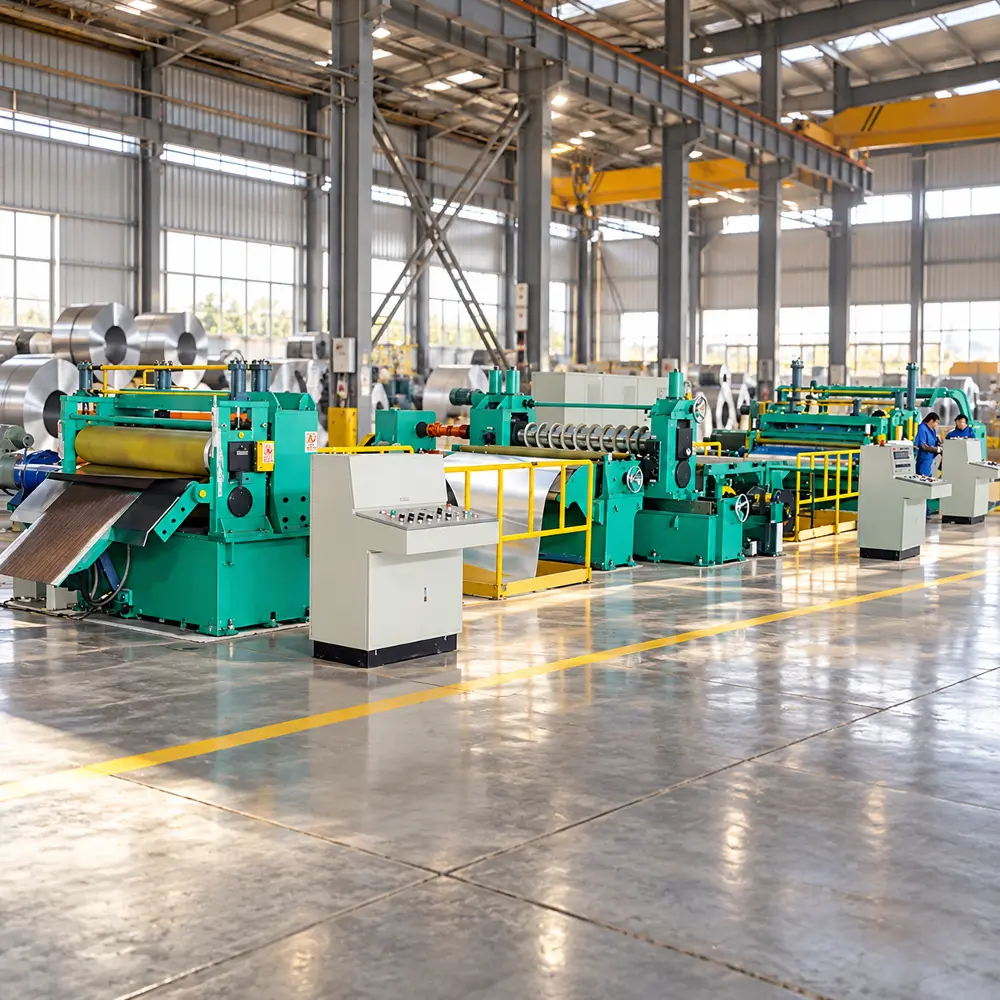
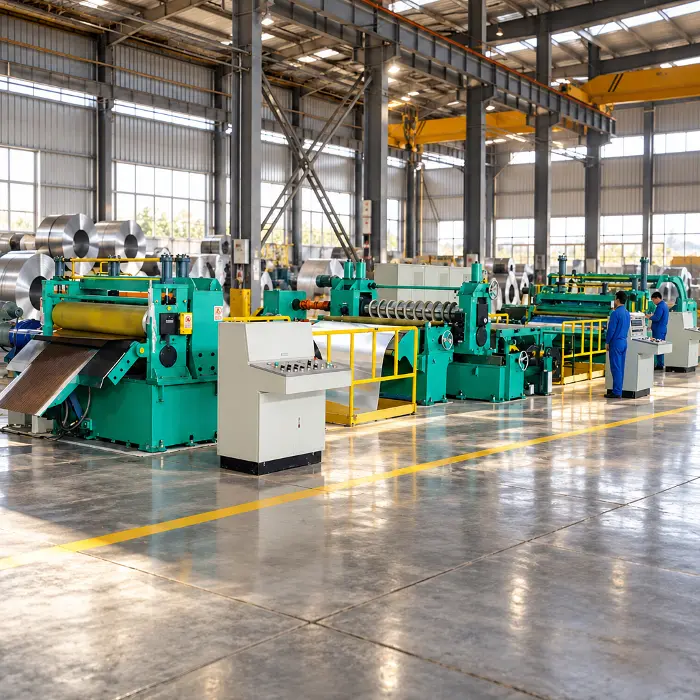
For us at Metmac, steel strip cutting machines represent one segment within a broader metalworking machinery portfolio that includes sheet metal equipment, air duct fabrication systems, and roll forming lines. Each category addresses specific transformation steps in the metal manufacturing chain, and slitting lines often serve as the upstream preparation stage that feeds downstream processes.
Common Operating Challenges and Solutions
Material edge wave—a wavy distortion along the strip edge—occurs when tension imbalance causes differential elongation across the strip width. Operators address this by adjusting tension zones independently for each strip, ensuring that thinner or narrower strips receive proportionally lower tension to prevent overstretching.
Knife wear manifests gradually as increasing burr height and rougher edge texture. Rather than waiting for quality complaints, experienced operators monitor cutting force trends displayed by the machine control system. A 15 to 20 percent increase in force signals imminent tool change, allowing scheduled replacement before defects appear.
Coil telescoping—when subsequent wraps shift laterally relative to previous wraps—complicates recoiling and creates handling hazards. This issue stems from inconsistent recoiler tension or misaligned exit pinch rollers. Correcting coil alignment and recalibrating recoiler torque curves resolves most telescoping problems.
Some facilities encounter strip camber, a lateral bow along the strip length. Camber originates from residual stress gradients in the master coil or asymmetric knife wear. Leveling unit adjustments can mitigate mild camber, but severe cases require returning to the master coil supplier to address upstream rolling inconsistencies.
Integration with Upstream and Downstream Processes
Steel strip cutting machines rarely operate in isolation. Upstream, they receive master coils from mills or importers, often requiring coordination around delivery schedules and storage capacity. Downstream, slit coils feed directly into tube mills, stamping presses, or secondary slitting operations for even narrower widths.
Some facilities integrate slitting lines with edge conditioning equipment that deburrs and chamfers the slit edges immediately after cutting. This in-line processing eliminates a separate handling and deburring step, reducing labor costs and minimizing the risk of edge damage during material transfer.
Coil packaging systems can be added to the exit end of slitting lines, automatically wrapping finished strips with protective film or paper and securing them with banding. This automation reduces handling time and ensures consistent packaging quality, particularly important for painted or polished surfaces susceptible to scratches.
Evaluating Return on Investment
Capital costs for industrial slitting lines range from mid-five figures for compact systems processing thin-gauge material to seven figures for heavy-duty lines handling structural steel. Justifying this investment requires quantifying the value of reduced material waste, eliminated outsourcing fees, and accelerated order fulfillment.
Material yield improvements of 3 to 5 percent are typical when transitioning from manual cutting or outsourced slitting to in-house automated lines. For a facility processing 1,000 tons monthly, a 4 percent yield gain recovers 40 tons of otherwise wasted material, translating to substantial monthly savings depending on metal prices.
Labor reallocation offers another benefit. Automated slitting lines require one to two operators compared to the four to six workers needed for manual cutting methods. Freed labor capacity can be redirected to higher-value tasks like quality inspection or maintenance, improving overall facility productivity.
Order lead time reduction strengthens customer relationships and enables just-in-time manufacturing strategies. When facilities control their own slitting capacity, they eliminate the
-
Steel Strip Cutting Machine: Engineering Precision in Modern Metal Processing
2026/10/10 -
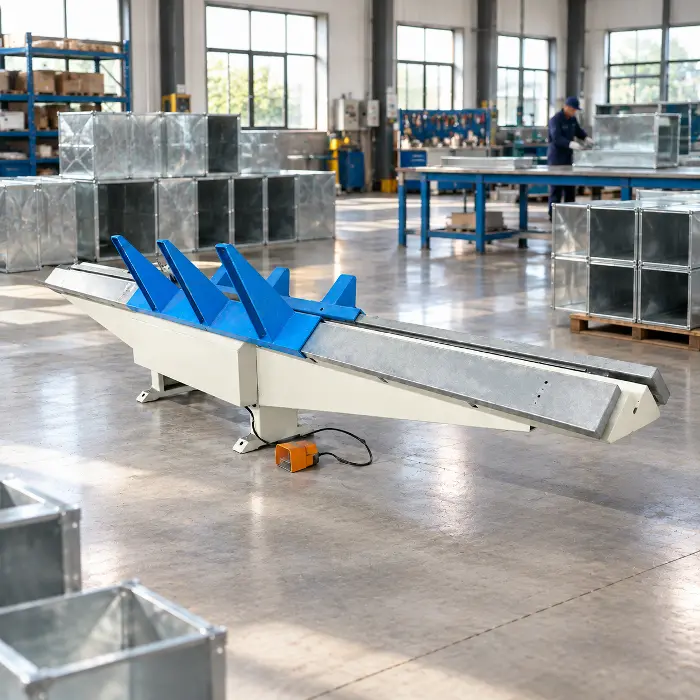
How Duct Zipper Machines Streamline Rectangular Channel Assembly
2026/10/09 -
Roll Forming Machines: How Sheet Metal Becomes Structural Shapes
2026/10/08 -
Duct Making Machines for High-Output Rectangular Duct Fabrication
2026/10/08
-
Sheet Metal Press Brake: Ultimate Guide to Precision Bending Technology in 2024
2026/03/13 -
Metal Punching Machine: Ultimate Guide to Precision Manufacturing in 2024
2026/03/11 -
Metal Folding Machine: Comprehensive Guide to Precision Bending in 2024
2026/03/09 -
Sheet Metal Equipment: Ultimate Guide to Industrial Fabrication Solutions in 2026
2026/03/06
-
Latest Technological Advancements in Rectangular Duct Machines
2024/05/11 -
Integrating Automation with Rectangular Duct Machines for Enhanced Productivity
2024/05/11 -
Metal Shear Machines- Essential Tools for Precision Metal Cutting
2024/05/11 -
Understanding the Role and Function of Steel Strip Slitting Machines
2024/05/11
-
A Guide to the Latest Innovations in Sheet Metal Folding Machines
2024/11/29 -
Key Features to Consider When Investing in a Sheet Metal Folding Machine
2024/11/28 -
Enhancing Precision with Advanced Sheet Metal Folding Machines
2024/11/27 -
How to Choose the Right Sheet Metal Folding Machine for Your Workshop
2024/11/26
