

How Duct Zipper Machines Streamline Rectangular Channel Assembly
Rectangular and square ventilation channels share a persistent challenge: seam integrity degrades faster than the surrounding sheet metal. Leaking joints waste conditioned air, compromise pressure balance, and trigger costly callbacks. Traditional manual folding and hammering demand repetition across hundreds of linear meters, introducing inconsistency at every operator handoff.
A duct zipper machine addresses this by automating edge fold formation and seam closure in a single pass. The equipment combines hydraulic forming pressure with inline sealant injection, delivering hermetic joints at speeds manual methods cannot match. For shops moving from hand-seaming to automated closing, understanding machine architecture and process sequencing clarifies where productivity gains concentrate.
Why Manual Seam Closing Limits Output
Hand-seaming rectangular ducts follows a repetitive sequence: align edges, fold one side, fold the opposing side, hammer the interlock flat, then apply external sealant. Each step introduces variability. Fold angles shift with operator fatigue. Hammer strikes create uneven compression. External sealant application often misses narrow gaps, leaving micro-leaks that surface only during pressure testing.
Scaling manual methods means adding more workers. Yet hiring rarely solves the core issue—human consistency has limits. A single operator might close fifteen meters of seam per hour under ideal conditions. Multiply that across twenty duct runs, and cycle time balloons. Rework from failed air-tightness tests compounds delay.
Shops attempting semi-automation often invest in edge folders but retain manual closure. This hybrid approach reduces fold inconsistency yet leaves the slowest step—seam interlocking—untouched. Throughput remains constrained by the manual bottleneck.
Single-Pass Forming Architecture
Duct zipper machines eliminate sequential handling by consolidating fold formation and closure into one continuous passage. The machine draws the duct through longitudinal guide tracks while forming rollers progressively shape edge folds into interlocking geometry. Hydraulic pressure maintains constant contact force, ensuring uniform fold depth regardless of sheet thickness variation.
Before final closure, a sealant injection nozzle introduces compound directly into the open seam cavity. This inline application guarantees sealant penetration into every crevice before metal edges compress. The closing roller set then locks the seam, embedding sealant between folded layers. The result is a hermetically sealed joint formed in one pass, without repositioning or secondary operations.
Working speed reaches fifteen meters per minute. A twenty-meter duct run that previously required multiple operators and extended manual effort now completes in under two minutes. The machine operator simply feeds the duct into the guide tracks, monitors seam alignment on the touch screen, and collects finished sections at the exit.
Hydraulic Drive and Frame Stability
Seam closing demands sustained, even pressure across the entire fold line. Pneumatic systems struggle with pressure consistency, especially when processing heavier gauge sheet metal. Hydraulic drive delivers stable force output, maintaining uniform roller contact even as material thickness fluctuates within the machine’s rated range.
The welded sheet metal frame anchors the hydraulic circuit and forming rollers. Reinforced bearing mounts prevent deflection under load, preserving roller alignment across thousands of operating hours. Misalignment—even fractional—causes incomplete seam closure or edge tearing. Heavy-duty construction mitigates this risk, translating directly into fewer adjustments and less unplanned downtime.
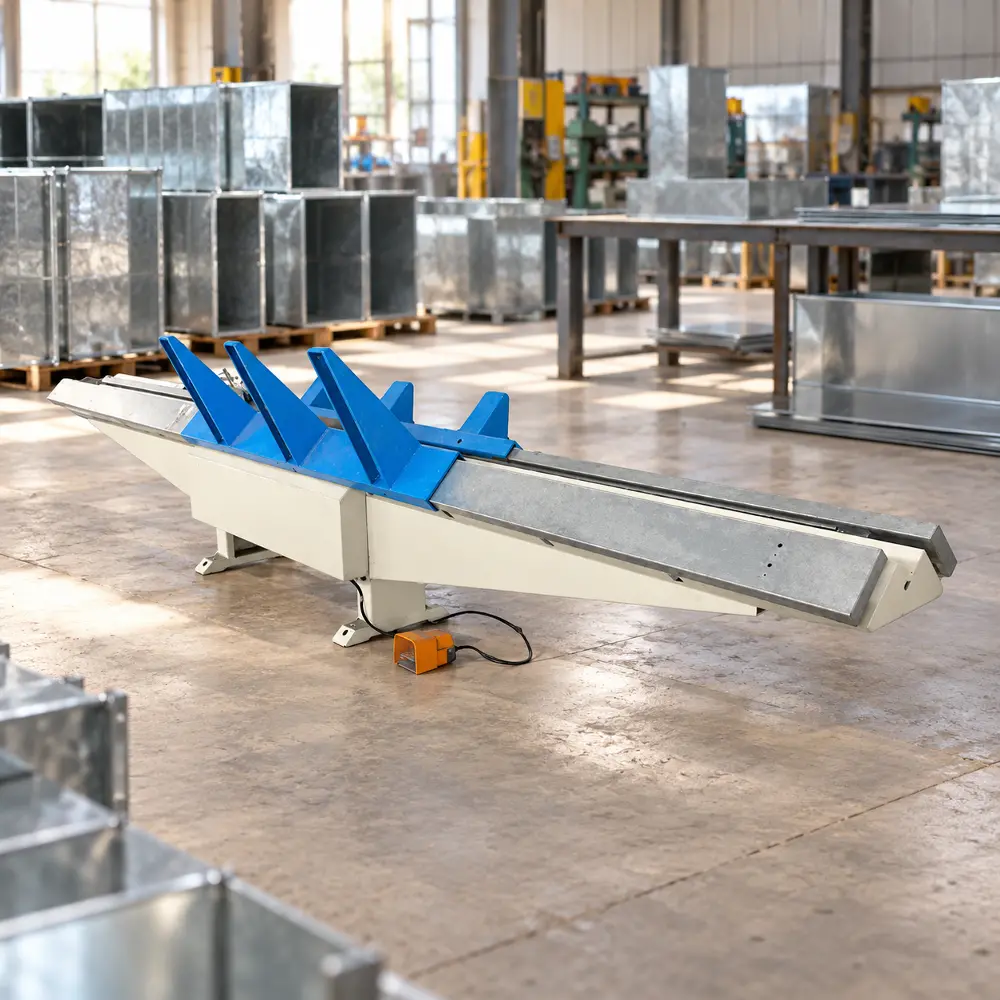
Support arms position the duct during transit. The machine includes two sets of three arms each, spaced along the working bed to stabilize rectangular sections as they pass through forming and closing zones. Adjustable height accommodates varying duct cross-sections without mechanical reconfiguration.
Inline Sealant Injection Mechanics
External sealant application after seam closure cannot reach interior seam surfaces. Capillary gaps remain unsealed, creating paths for air leakage under operating pressure. Inline injection solves this by introducing sealant before the seam closes, allowing compound to coat both interior fold faces.
The injection nozzle sits immediately upstream of the final closing roller. As the duct advances, the nozzle dispenses a controlled bead into the open seam. Closing pressure then distributes sealant evenly along the fold line, squeezing excess outward while filling interior voids. The embedded compound cures within the joint, forming a continuous barrier against air migration.
Sealant viscosity and injection rate require calibration to match duct travel speed. Too viscous, and the compound fails to spread before closure. Too fluid, and it seeps out prematurely. The machine’s hydraulic system regulates both injection pressure and duct feed rate, maintaining the precise balance needed for consistent sealing.
Material Thickness and Model Selection
Sheet metal gauge directly influences forming force requirements. Model HF-I handles material from 0.5 to 1.0 millimeter, suitable for light-duty residential and commercial ductwork. Model HF-II extends capacity to 1.25 millimeters, accommodating heavier industrial applications where structural rigidity and pressure resistance matter.
Minimum duct dimensions differ between models. HF-I processes sections as small as 100 by 100 millimeters, appropriate for branch runs and terminal diffusers. HF-II begins at 200 by 200 millimeters, targeting main trunk lines and large-volume distribution channels. Selecting the wrong model either underutilizes capacity or risks machine overload.
| Parameter | Model HF-I | Model HF-II |
|---|---|---|
| Thickness Range | 0.5 – 1.0 mm | 1.0 – 1.25 mm |
| Minimum Duct Size | 100 x 100 mm | 200 x 200 mm |
| Working Speed | 15 m/min | 15 m/min |
| Motor Power | 5.5 kW | 5.5 kW |
| Machine Weight | 710 kg | 710 kg |
Both models share identical working speed and motor power. The distinction lies in structural reinforcement and roller geometry tailored to different gauge ranges.
Touch Screen Control and Mode Switching
Operating a duct zipper machine does not demand extensive mechanical expertise. The touch screen interface displays real-time parameters: feed speed, hydraulic pressure, sealant level, and seam alignment status. Operators adjust settings with on-screen controls, switching between manual and automated modes as production demands shift.
Manual mode grants direct control over feed rate and roller engagement, useful during initial setup or when processing non-standard duct geometries. Automated mode synchronizes feed, forming, injection, and closure into a single programmed cycle, minimizing operator intervention once parameters are set.
Switching modes takes seconds. This flexibility proves valuable when running mixed batches—automated operation for long repetitive runs, manual control for short custom sections. The interface logs cycle counts and alerts for maintenance intervals, supporting predictive upkeep rather than reactive repair.
Application Across HVAC and Industrial Ducting
Rectangular and square duct profiles dominate commercial HVAC installations. Office buildings, hospitals, and data centers route conditioned air through hundreds of meters of fabricated ductwork. Each seam represents a potential leak point. Hermetic closure reduces energy loss and maintains designed airflow distribution.
Sheet metal fabrication workshops benefit from the machine’s ability to process varying duct lengths without retooling. A single setup handles everything from short branch connectors to twenty-meter trunk sections. Continuous seam closing eliminates the patchwork quality often seen in manually assembled systems.
Industrial applications demand airtight ducts for fume extraction, dust collection, and process ventilation. Leak rates directly affect system performance—lost suction compromises capture efficiency, forcing larger fans and higher energy consumption. The inline sealant injection inherent to duct zipper machines addresses this, delivering joints that meet stringent air-tightness specifications.
Integration Into Existing Production Lines
Adding a duct zipper machine to an established fabrication line requires evaluating upstream and downstream processes. The machine receives pre-formed rectangular or square duct sections with raw edges ready for folding. Upstream equipment—shears, brakes, or roll formers—must produce dimensionally consistent blanks to avoid feed misalignment.
Downstream handling involves stacking, packaging, or direct installation. At fifteen meters per minute, the machine outputs finished duct faster than most manual crews can handle material flow. Allocating buffer zones or installing automated conveyor systems prevents bottlenecks from shifting from seam closing to material handling.
Electrical requirements depend on regional supply standards. The machine specifies customized voltage, accommodating diverse grid configurations without additional transformers. Motor power of 5.5 kilowatts sits within the capacity of standard industrial circuits, simplifying installation.
Maintenance Considerations and Operational Longevity
Hydraulic systems require periodic fluid checks and filter replacement. Contaminated hydraulic fluid degrades pressure stability, causing inconsistent forming force. Establishing a routine inspection schedule—weekly fluid level checks, monthly filter changes—extends component life and maintains output quality.
Forming rollers experience gradual wear from continuous contact with sheet metal edges. Roller surface condition directly affects seam quality. Visible scoring or flattening signals the need for resurfacing or replacement. Shops processing higher volumes should stock spare roller sets to minimize downtime during changeovers.
Sealant injection nozzles clog when compound residue accumulates. Flushing nozzles at the end of each production shift prevents buildup. Using manufacturer-recommended sealant formulations reduces clogging incidents, as viscosity and solids content are calibrated to the injection system’s flow characteristics.
The welded frame demands minimal upkeep beyond routine cleaning. Accumulated metal shavings or sealant drips should be removed to prevent interference with guide tracks. Bearing lubrication follows standard industrial intervals, typically every five hundred operating hours.
How Seam Quality Translates to System Performance
Duct leakage rates directly influence HVAC system efficiency. A poorly sealed joint loses conditioned air before it reaches intended zones, forcing air handlers to work harder to maintain setpoint temperatures. Energy consumption rises, operating costs climb, and equipment lifespan shortens under sustained overload.
Hermetic seams produced by duct zipper machines reduce leakage to negligible levels. Pressure testing consistently shows tighter results compared to manually closed seams. This translates into predictable airflow distribution, lower fan energy draw, and improved thermal comfort in served spaces.
For contractors, reliable seam quality reduces callback risk. Failed pressure tests trigger rework, delaying project completion and eroding profit margins. Consistent machine-formed joints pass inspection on the first attempt, keeping schedules intact and avoiding penalty clauses.
Comparing Automated Closing to Alternative Methods
Traditional hand-seaming remains common in low-volume shops or remote job sites where transporting heavy equipment proves impractical. Manual methods offer flexibility—workers adapt to irregular geometries without reconfiguring machinery. However, output speed and consistency cannot compete with automated systems when production volume justifies investment.
Snap-lock seaming machines partially automate closure but lack inline sealant injection. Joints rely on mechanical interlock alone, acceptable for low-pressure applications but insufficient where air-tightness matters. Adding external sealant after closure reintroduces manual steps and inconsistency.
Welded seams provide maximum strength and hermetic integrity but require skilled labor and generate heat distortion. Welding suits high-pressure or corrosive environments yet proves too slow and expensive for standard HVAC ductwork. Duct zipper machines occupy the middle ground—faster than welding, more reliable than manual folding, and suitable for the bulk of commercial and industrial applications.
Evaluating Return on Investment
Capital cost for a duct zipper machine varies with model and supplier, typically ranging from moderate to significant investment levels depending on capacity and automation features. Calculating payback period requires comparing current labor costs against projected productivity gains.
A shop closing seams manually at fifteen meters per hour per worker, paying standard wages, accumulates substantial labor expense across hundreds of duct runs. Automating closure at fifteen meters per minute reduces direct labor significantly. Even accounting for machine operation and maintenance, the reduction in labor hours translates to measurable cost savings within the first year of operation.
Indirect savings emerge from reduced rework and faster project turnaround. Consistent seam quality lowers defect rates, cutting material waste and labor spent on corrections. Faster cycle times enable shops to accept more contracts without expanding floor space or headcount.
Practical Considerations for First-Time Buyers
Shops transitioning to automated seam closing should assess current production volume and project mix. A facility processing less than fifty duct runs monthly may struggle to justify the investment. Operations handling hundreds of runs or targeting growth into larger commercial projects find clearer value.
Floor space requirements deserve early attention. At over five meters in length, the machine demands dedicated placement with clearance for material feed and exit. Shops with constrained layouts may need to reorganize workstations or expand facilities before installation.
Operator training typically spans a few days. Workers familiar with sheet metal fabrication adapt quickly, though understanding hydraulic system basics and touch screen navigation requires focused instruction. Suppliers often provide on-site training as part of the purchase agreement.
For us at Metmac, supporting customers through this transition means providing not just the equipment but also practical guidance on integration, maintenance, and process optimization. Metalworking machinery performs best when operators understand both the machine’s capabilities and the production context it serves.
Long-Term Scalability and Process Evolution
Investing in a duct zipper machine positions a shop for future expansion. As project volumes grow, the machine’s capacity scales without requiring proportional labor increases. Adding a second shift or running extended hours leverages existing capital investment rather than multiplying headcount.
Process evolution often follows automation. Once seam closing no longer constrains throughput, bottlenecks shift to upstream operations—cutting, forming, or material handling. Identifying and addressing these new constraints becomes the next phase of efficiency improvement. Automated seam closing serves as a foundation, enabling subsequent investments in complementary equipment to deliver compounded productivity gains.
Technological advancements in hydraulic controls, sensor feedback, and programmable logic will continue refining duct zipper machine performance. Early adopters gain operational experience that informs future upgrades, positioning them ahead of competitors still relying on manual methods.
Rectangular and square duct fabrication demands
-
How Duct Zipper Machines Streamline Rectangular Channel Assembly
2026/10/09 -
Roll Forming Machines: How Sheet Metal Becomes Structural Shapes
2026/10/08 -
Duct Making Machines for High-Output Rectangular Duct Fabrication
2026/10/08 -
Sheet Metal Machine Selection for Precise Bending and Folding
2026/10/08
-
Sheet Metal Press Brake: Ultimate Guide to Precision Bending Technology in 2024
2026/03/13 -
Metal Punching Machine: Ultimate Guide to Precision Manufacturing in 2024
2026/03/11 -
Metal Folding Machine: Comprehensive Guide to Precision Bending in 2024
2026/03/09 -
Sheet Metal Equipment: Ultimate Guide to Industrial Fabrication Solutions in 2026
2026/03/06
-
A Guide to the Latest Innovations in Sheet Metal Folding Machines
2024/11/29 -
Key Features to Consider When Investing in a Sheet Metal Folding Machine
2024/11/28 -
Enhancing Precision with Advanced Sheet Metal Folding Machines
2024/11/27 -
How to Choose the Right Sheet Metal Folding Machine for Your Workshop
2024/11/26
