


Precision Metal Forming Machines: What Separates Accurate Bends From Scrapped Sheet
Anyone running a fabrication shop knows the gap between a drawing and a finished part. Precision metal forming machines close that gap, turning flat sheet into parts that actually match tolerance on the first try. The real question is why some machines hold angle after thousands of cycles while others drift within a single shift.
That drift is rarely about operator skill. It comes down to how a machine controls force, measures position, and reacts to the sheet itself. Thickness varies by a tenth of a millimeter here, temperature shifts there, and a machine without compensation just bends through those variables blind. The result shows up downstream, in parts that need rework or get scrapped outright.
Why Bending Accuracy Breaks Down on Older Equipment
Traditional hydraulic press brakes rely on throttling valves to control ram speed and pressure. That throttling introduces small pressure fluctuations, and those fluctuations translate directly into angle variation across a long bend or a long production run.
There’s also the thermal problem. Hydraulic oil heats up during continuous operation, and as viscosity changes, so does the force delivered at the ram. A machine with no temperature compensation will produce a slightly different bend angle at hour six than it did at hour one, even with identical settings.
Material inconsistency compounds this further. Mill-sourced sheet metal rarely holds a perfectly uniform thickness across a coil. A press brake that reads every sheet the same way, regardless of thickness deviation, is building error into every part before the operator even touches the controls.
Servo-Hydraulic Design and Why It Changes the Equation
Servo-hydraulic press brakes replace constant-flow pumps and throttle valves with a direct-drive servo motor that adjusts pump output on demand. Instead of running at full flow and bleeding off excess pressure, the pump only moves as much oil as the current operation requires.
The Metmac Dual Servo Press Brake, part of the NCP DS Series, is built around this principle. According to its product documentation, the dynamic variable pump flow design cuts energy consumption by more than 70 percent compared to conventional hydraulic presses, with the 200-ton model drawing just 18 kWh across an 8-hour shift.
That efficiency gain isn’t just a utility bill story. A pump that isn’t fighting its own throttle valve produces smoother, more consistent force at the ram, which is where real bending accuracy starts.
Positioning Accuracy at the Micron Level
Repeatability is the quiet metric that separates a precision machine from an ordinary one. A press brake can bend a single part perfectly and still fail in production if it can’t repeat that bend five hundred times in a row.
The NCP DS Series pairs its direct-drive mechanism with a raster scale feedback system rated at 1nm resolution. Per the manufacturer’s specifications, this combination delivers repeatable positioning accuracy of ±0.002mm, without the throttling fluctuations that plague conventional hydraulic systems.
For shops producing aluminum enclosures or structural brackets where angle consistency matters across a batch, that level of repeatability is the difference between a part that assembles cleanly and one that needs a rework station. Per the manufacturer’s documentation, angle consistency as tight as ±0.05° has been achieved on 3mm aluminum plate.
Material Compensation: Solving the Thickness and Temperature Problem
Even a mechanically perfect press brake will produce inconsistent bends if it can’t account for the sheet in front of it. This is where intelligent compensation systems earn their place in modern forming equipment.
The NCP DS Series includes a pre-stored library of over 500 material parameters, allowing the control system to apply the right bending logic for a given alloy and gauge automatically rather than relying on manual trial bends. Beyond material selection, the system performs real-time compensation for:
- Sheet thickness deviation of up to ±0.1mm, adjusting ram position mid-cycle to maintain target angle
- Temperature drift as fine as ±0.01°/℃, correcting for the thermal creep that throws off all-day production runs
- Pressure fluctuation held under ±0.1 Bar, which keeps force delivery stable from the first bend to the last
This matters most on long runs. A shop bending the same bracket for six hours needs the two-hundredth part to match the second part, not drift slowly out of spec as oil temperature climbs.
Speed Without Sacrificing Control
Precision and speed are usually treated as a tradeoff. Faster ram movement tends to overshoot target position, and slower movement protects accuracy at the cost of throughput. Direct-drive servo systems narrow that gap by decoupling speed from the hydraulic lag that causes overshoot.
The NCP DS Series reaches rapid descending speeds of 220 to 230 mm/s, switches displacement in 8 milliseconds, and accelerates its motor from 0 to 3000 rpm in 50 milliseconds, based on its published specifications. That kind of response lets the ram approach the sheet quickly, then slow precisely into the bending zone without the hesitation that older systems need to avoid overshoot.
Technical Specifications at a Glance
Choosing between tonnage and bed length options depends heavily on the part geometry a shop runs most often. The table below summarizes the core specification range across the series.
| Specification | Range |
|---|---|
| Bending Pressure Capacity | 100 Ton – 200 Ton |
| Workbench Length | 2500 mm – 4100 mm |
| Throat Depth | 400 mm – 500 mm |
| Ram Stroke | 200 mm |
| Repeatable Positioning Accuracy | ±0.002 mm |
| Slider Moving Down Speed | 220 – 230 mm/s |
| Main Motor Power | 15 kW – 22 kW |
| Noise Level | < 68 dB |
| Oil Replacement Cycle | 8000 hours |
| Machine Weight | 6500 kg – 13500 kg |
Reading the Control Interface and Workholding Layout
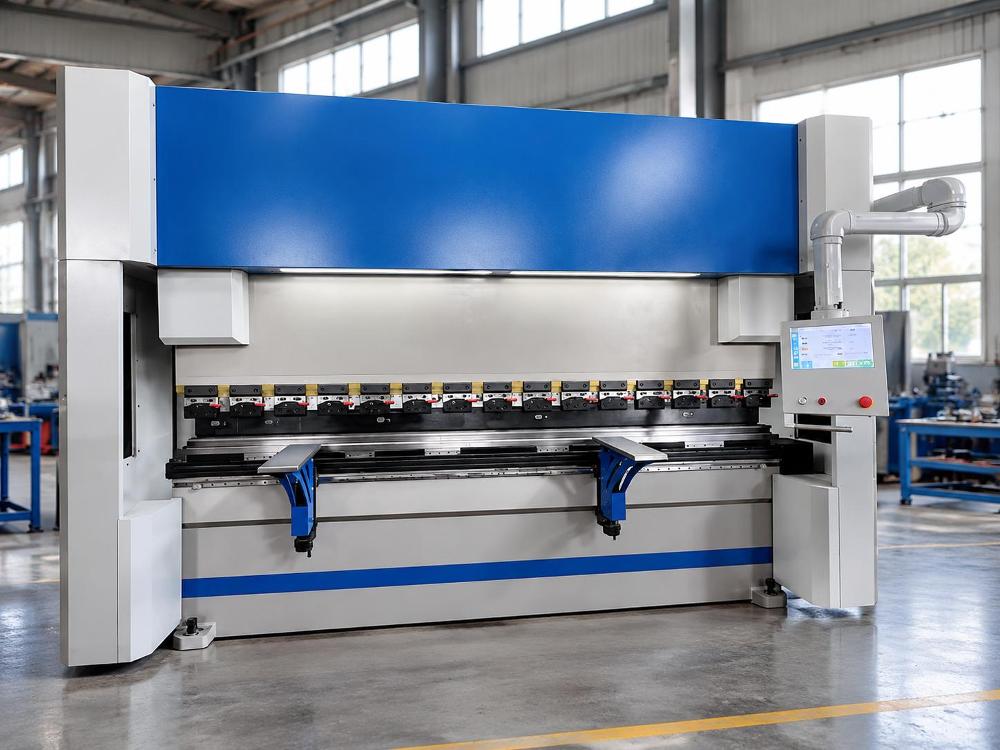
The physical layout of a press brake affects daily workflow as much as its internal hydraulics. The NCP DS Series uses a segmented multi-clamp upper punch holder system paired with a full-length lower die bed, which lets operators configure tooling for mixed part runs without swapping the entire die set.
Front sheet support brackets extend from the frame to steady longer workpieces during the bend, reducing the chance of the sheet dipping out of position under its own weight. The CNC controller itself sits on an articulated overhead arm, positioning the touchscreen interface within easy reach regardless of where the operator stands along the bed.
Choosing the Right Tonnage and Bed Length
Matching machine size to actual part requirements avoids both underpowered struggling and oversized equipment sitting underused. A practical selection process looks like this:
- Identify the longest bend line your parts require, then add clearance margin to select workbench length.
- Calculate required tonnage based on material thickness, tensile strength, and bend length, rather than estimating from similar past jobs.
- Confirm throat depth is sufficient for box or pan forming if deep-profile parts are part of the regular mix.
- Check column width against the widest sheet the shop processes, since narrow columns limit part flexibility down the line.
- Factor in floor space using overall dimensions, which range from roughly 3100mm to 4500mm in length depending on tonnage.
Where This Fits in a Modern Production Floor
Energy-conscious manufacturing isn’t just a compliance checkbox anymore. Shops operating under noise restrictions or sustainability targets need equipment that fits those constraints without giving up output. A noise level under 68 dB and zero hydraulic leakage, as specified for the NCP DS Series, support both quieter workshop environments and reduced facility cleanup from oil contamination.
Longer oil service intervals also reduce the maintenance burden that typically eats into uptime. An 8000-hour oil replacement cycle means fewer scheduled stops, which adds up across a year of continuous production.
Common Questions About Servo Press Brake Performance
Does lower energy consumption mean lower bending force?
No. Energy savings come from the pump only drawing power the current motion requires, not from reducing available tonnage. The press still delivers its full rated bending pressure when needed.
How does material compensation actually work during a bend?
The control system references its stored material library and adjusts ram position in real time based on measured sheet thickness and temperature drift, rather than applying a fixed bend profile regardless of conditions.
Is a servo-hydraulic press brake harder to maintain than a standard hydraulic unit?
Based on the documented 8000-hour oil change interval and zero-leakage design, maintenance intervals tend to be longer than conventional hydraulic systems, which typically require more frequent fluid service.
What kind of parts benefit most from ±0.002mm positioning accuracy?
Parts with tight angular tolerance requirements across long production runs, such as aluminum enclosures, structural brackets, and assemblies where multiple bent components need to fit together without manual adjustment.
Shops evaluating new equipment should weigh daily part volume, tolerance requirements, and facility constraints like noise and power draw together, not in isolation. For us at Metmac, that’s the practical framework behind the NCP DS Series: precision metal forming machines built to hold tolerance under real production conditions, not just on a spec sheet.
-
Precision Metal Forming Machines: What Separates Accurate Bends From Scrapped Sheet
2026/10/12 -
What to Look for in an HVAC Folding Machine Manufacturer
2026/10/11 -
Steel Strip Cutting Machine: Engineering Precision in Modern Metal Processing
2026/10/10 -
How Duct Zipper Machines Streamline Rectangular Channel Assembly
2026/10/09
-
Sheet Metal Press Brake: Ultimate Guide to Precision Bending Technology in 2024
2026/03/13 -
Metal Punching Machine: Ultimate Guide to Precision Manufacturing in 2024
2026/03/11 -
Metal Folding Machine: Comprehensive Guide to Precision Bending in 2024
2026/03/09 -
Sheet Metal Equipment: Ultimate Guide to Industrial Fabrication Solutions in 2026
2026/03/06
-
Latest Technological Advancements in Rectangular Duct Machines
2024/05/11 -
Integrating Automation with Rectangular Duct Machines for Enhanced Productivity
2024/05/11 -
Metal Shear Machines- Essential Tools for Precision Metal Cutting
2024/05/11 -
Understanding the Role and Function of Steel Strip Slitting Machines
2024/05/11
-
A Guide to the Latest Innovations in Sheet Metal Folding Machines
2024/11/29 -
Key Features to Consider When Investing in a Sheet Metal Folding Machine
2024/11/28 -
Enhancing Precision with Advanced Sheet Metal Folding Machines
2024/11/27 -
How to Choose the Right Sheet Metal Folding Machine for Your Workshop
2024/11/26
