

Metalworking Equipment: Choosing the Right Machinery for Modern Fabrication
Metalworking equipment forms the backbone of nearly every manufacturing operation that touches sheet metal. From automotive panels to HVAC ductwork, the machines that cut, bend, and shape raw plate determine whether a shop can meet tolerances, deadlines, and cost targets at the same time. Choosing the wrong equipment doesn’t just slow production, it introduces defects that ripple through an entire supply chain.
This guide looks at what metalworking equipment actually does, why bending accuracy is often the hardest problem to solve, and how to match machine specifications to real production needs.
What Counts as Metalworking Equipment
The term covers a wide category of machines used to process, grind, bend, weld, or otherwise reshape metal stock. In a typical fabrication shop, this includes shears, press brakes, roll forming lines, and duct making equipment, each handling a different stage of the transformation from flat sheet to finished part.
None of these machines work in isolation. A shear that cuts a plate to size is only useful if the bending equipment downstream can hold the same tolerance. Mismatched precision between stations is a common, underappreciated cause of scrap.
Why Bending Accuracy Is Harder Than It Looks
Bending seems simple on paper: clamp the sheet, apply force, achieve an angle. In practice, thicker plates fight back. Steel has memory, and it springs back slightly after the load releases, which means the machine has to overbend by a calculated margin to land on the target angle.
This is where frame rigidity matters more than most buyers expect. If the machine’s structure flexes under load, that springback becomes unpredictable across the length of the sheet. One end bends to 90 degrees, the other creeps to 92, and the part fails inspection even though the operator did everything right.
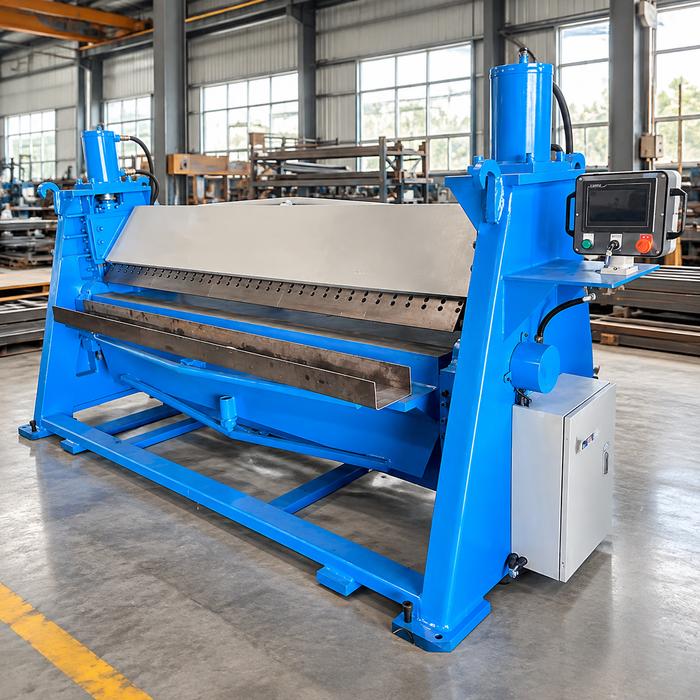
A heavy-duty hydraulic bending machine addresses this by using a heavy steel welded frame that has been stress-relieved. Stress relieving removes internal tension left over from welding, so the frame doesn’t warp or twist once it’s put under repeated load. The result is a structure that stays geometrically stable bend after bend, rather than drifting out of tolerance over a production run.
Hydraulic Drive vs. Mechanical Drive: What Actually Changes
Older mechanical press brakes rely on flywheels and clutches, which deliver force in a fixed stroke pattern. Hydraulic systems, by contrast, use fluid pressure through cylinders, giving the operator finer control over speed, dwell time, and tonnage at any point in the stroke.
That control translates into real shop-floor benefits:
- Adjustable force delivery: hydraulic cylinders can apply full tonnage only when needed, reducing wear compared to mechanical systems that deliver a fixed stroke every cycle.
- Smoother approach to the workpiece: slower final approach speed reduces the risk of overshooting the bend angle on thin materials.
- Better handling of variable plate thickness: the same machine can shift between a 0.2 mm stainless sheet and a 6 mm mild steel plate without retooling the entire drive train.
According to the product specifications, the machine’s imported hydraulic components and hydraulic system are designed to deliver stable performance and consistent bending force across operating cycles.
CNC Control: Where Precision Meets Usability
A rigid frame and a strong hydraulic system still need a control layer that translates operator intent into exact movement. This is the role of the CNC system on a modern bending machine. Rather than relying on mechanical stops and operator judgment, the CNC controller positions the backgauge and tracks the folding beam angle electronically.
For shops running mixed production, this matters in three practical ways. First, programmed bend sequences can be recalled instantly, so switching from one part number to another doesn’t require re-measuring from scratch. Second, the system supports manual, single-cycle, and continuous operating modes, letting the same machine handle a one-off prototype and a long production run without a hardware change. Third, angle accuracy becomes repeatable across operators, not dependent on one person’s experience with the machine.
Matching Folding Length and Thickness to Your Parts
Not every job needs the largest machine on the floor. Oversized equipment wastes floor space and capital, while undersized equipment simply can’t process the part. The right starting point is the material spec sheet for the parts you actually run.
| Parameter | Typical Range | Why It Matters |
|---|---|---|
| Folding thickness, mild steel | 0.2–6.0 mm | Determines maximum plate gauge the machine can bend without exceeding tonnage limits |
| Folding thickness, stainless steel | 0.2–3.0 mm | Stainless requires more force per mm than mild steel, so its max thickness is lower |
| Folding length | 2000–6000 mm | Must match or exceed the longest edge of parts in production |
| Folding angle range | 20°–120° | Covers most structural and enclosure bending needs |
| Hydraulic working pressure | up to 25 MPa | Higher pressure supports thicker plate and longer folding beams |
Longer folding beams generally come paired with heavier frames and higher machine weight, since the structure needs more mass to resist deflection across a wider span. A 6000 mm folding length machine, for instance, weighs considerably more than a 2000 mm unit built for the same thickness range, simply because the beam has to stay straight over three times the distance.
Common Applications Across Industries
Heavy-duty bending equipment shows up wherever sheet metal needs to become a structural or enclosure part rather than staying flat. Typical uses include:
- Sheet metal fabrication shops producing brackets, panels, and custom parts for other manufacturers.
- Electrical and industrial cabinet production, where consistent folding angles are needed to keep doors and panels aligned.
- Metal structural component manufacturing, including frames and supports that carry mechanical load.
- Machinery enclosure production, where bent sheet metal forms protective housings around equipment.
Each of these applications has a different tolerance for error. A cabinet door that’s off by a degree might still close. A structural bracket that’s off by a degree might not fit its mating part at all. Knowing which category your work falls into should inform how much you invest in frame rigidity and control precision upfront.
Frequently Asked Questions
Does a thicker plate always need a bigger machine?
Not necessarily bigger in footprint, but it does need higher tonnage capacity. A compact machine rated for thin gauge stainless will stall or damage its hydraulics if pushed to bend thick mild steel plate. Check the thickness rating for the specific material, not just a generic tonnage number.
Why does the same machine list different thickness limits for steel and stainless?
Stainless steel has higher tensile strength than mild steel, so it resists bending more and demands greater force per millimeter of thickness. That’s why folding thickness specs are usually given separately for each material.
Can one machine handle both prototype work and long production runs?
Yes, provided the CNC control supports manual, single, and continuous modes. Manual mode suits one-off prototypes where an operator adjusts on the fly, while continuous mode keeps a steady cycle rate for repetitive parts.
What causes bending angle drift over a production run?
Frame flex under repeated load is the most common cause. A stress-relieved welded frame resists this drift better than a frame with residual welding stress, because it doesn’t gradually deform as tonnage is applied cycle after cycle.
Final Considerations
Selecting metalworking equipment isn’t about finding the machine with the most impressive spec sheet. It’s about matching folding length, thickness capacity, and control flexibility to the parts a shop actually produces day to day. A press brake sized for 6 mm mild steel is wasted capital in a shop that only ever bends thin stainless enclosures, and the reverse mismatch simply won’t do the job.
For us, working with fabricators across sheet metal, ductwork, and structural production, the pattern is consistent: the shops that get the most out of their bending equipment are the ones that start with their part drawings, not the machine catalog. Whether the application is a cabinet panel or a structural frame, the right piece of metalworking equipment is the one whose tolerance, force, and control range line up with what’s actually crossing the shop floor.
-
Metalworking Equipment: Choosing the Right Machinery for Modern Fabrication
2026/10/08 -
Choosing Metalworking Machinery for Precision Sheet Bending Operations
2026/10/08 -
Press Metal Machine: The Definitive Guide to Precision Metal Forming
2026/03/12 -
Metal Punching Machine: The Ultimate Guide to Precision Hole Punching
2026/03/10
-
Sheet Metal Press Brake: Ultimate Guide to Precision Bending Technology in 2024
2026/03/13 -
Metal Punching Machine: Ultimate Guide to Precision Manufacturing in 2024
2026/03/11 -
Metal Folding Machine: Comprehensive Guide to Precision Bending in 2024
2026/03/09 -
Sheet Metal Equipment: Ultimate Guide to Industrial Fabrication Solutions in 2026
2026/03/06
-
Understanding the Role and Function of Steel Strip Slitting Machines
2024/05/11 -
Maintenance Tips for Longevity of HVAC Duct Machines
2024/05/11 -
Innovations in Steel Strip Slitting Machine Design and Technology
2024/05/11 -
Improving Accuracy in Metal Fabrication with Laser Metal Shear Machines
2024/05/11
-
A Guide to the Latest Innovations in Sheet Metal Folding Machines
2024/11/29 -
Key Features to Consider When Investing in a Sheet Metal Folding Machine
2024/11/28 -
Enhancing Precision with Advanced Sheet Metal Folding Machines
2024/11/27 -
How to Choose the Right Sheet Metal Folding Machine for Your Workshop
2024/11/26
