


Choosing HVAC Duct Folding Machines for Flange-Safe Bending
Sheet metal shops building rectangular ductwork run into the same bottleneck again and again. A duct wall has already been punched and notched, the TDF or drive cleat flange is formed, and then the folding step either crushes that flange or leaves a bend that is a degree or two off square. Multiply that error across a full run of fittings and the assembly crew ends up fighting gaps instead of sealing them. This is the exact gap that hvac duct folding machines are built to close, and the difference between a generic folder and one engineered for flange clearance shows up the moment you load a pre-formed sheet.
Why Flange-Formed Sheets Break Standard Folders
Most sheet metal folders were never designed with a flange in mind. Their blades assume a flat, uninterrupted edge, so when a TDF flange or drive cleat lip meets the bending beam, something has to give. Either the blade rides over the flange and dents it, or the operator has to stop, reposition, and fold in smaller segments.
That workaround costs time, and it costs consistency. Every manual repositioning introduces a slightly different clamping pressure, and that variance shows up later as duct sections that don’t sit flush against each other on the installation line. For shops running TDF flange systems at volume, this isn’t an occasional annoyance, it’s a structural limitation of the tooling.
How a Flange-Friendly Blade Changes the Fold
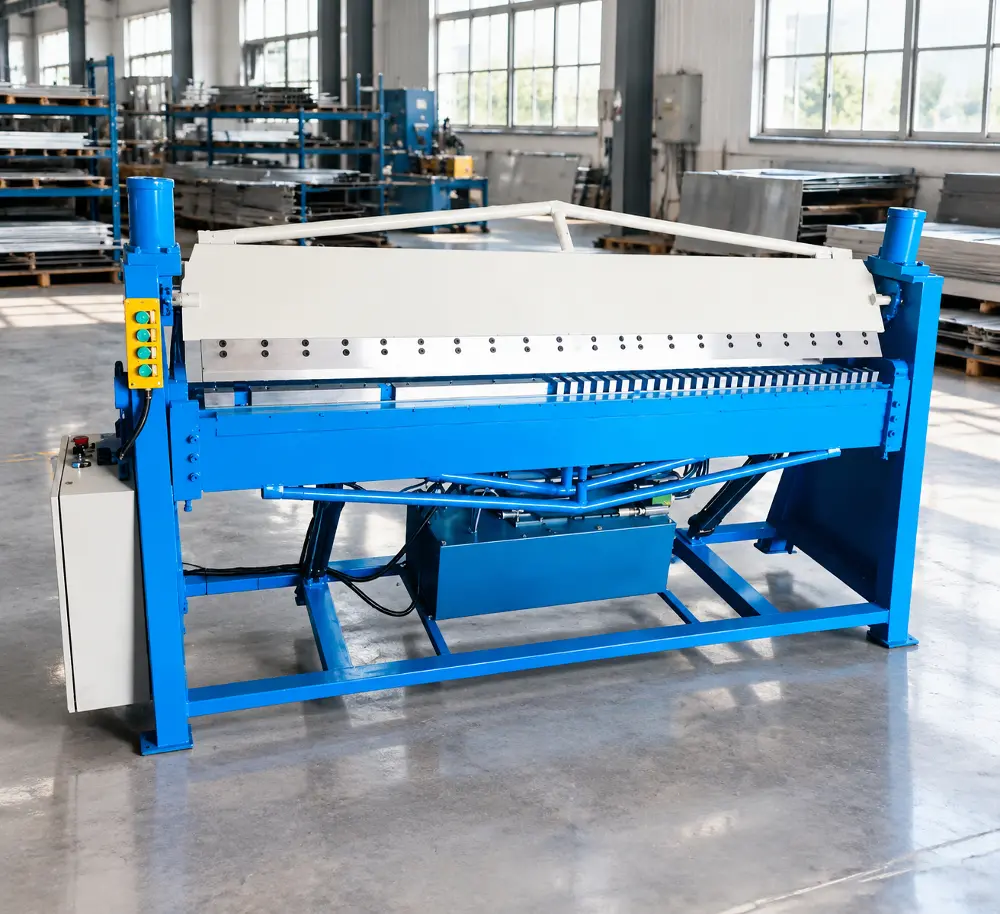
The core design decision in the Duct Hydraulic Folding Machine is a folding blade shaped specifically to clear TDF and drive cleat flanges as the sheet moves into position. Instead of treating the flange as an obstacle, the blade geometry accounts for it, letting the sheet seat correctly before the fold executes.
In practical terms, this means an operator can load a sheet with its flange already formed and run the fold without stopping to guard the joint by hand. The blade simply doesn’t make contact with the flange edge during the stroke. That single geometric choice is what separates a duct-specific folder from a repurposed general-purpose bender.
Consider the downstream effect on an installation crew. A duct section with an undamaged flange seats evenly against its mating piece, so the gasket or sealant does its job without compensating for a dented lip. Fabrication-stage precision becomes assembly-stage speed, which is really the whole economic argument for investing in purpose-built equipment.
Holding the Angle: Why Sensor-Based Control Matters
Flange clearance solves one problem. Angle accuracy solves another, and it’s arguably the more persistent one. Rectangular duct bodies depend on clean 90-degree corners, and a folder that drifts even slightly off square compounds that error across every subsequent panel in the assembly.
This machine addresses that with an adjustable electrical angle sensor built into the folding mechanism. Rather than relying on a mechanical stop that wears over thousands of cycles, the sensor reads the bend angle electronically and governs the fold accordingly. The practical benefit is repeatability: the hundredth fold of the day should match the first one.
For shops producing duct in batches rather than one-off runs, that consistency is what keeps rework off the schedule. A square duct body is also easier to seal, easier to hang, and far less likely to generate air leakage at the seams, which matters more as energy codes tighten on commercial ventilation systems.
Frame Construction and Why It’s Not Just a Spec Sheet Line
A folding machine’s frame rarely gets much attention in sales conversations, but it determines whether the angle sensor and blade geometry actually hold up over time. This machine uses a fully welded steel frame that has gone through heat treatment and high-frequency vibration relief before assembly.
That process matters for a specific reason. Welding introduces internal stress into steel, and if that stress isn’t relieved, the frame can shift slightly as it ages, usually under the repeated load cycling that a production folder experiences daily. A frame that moves, even by a fraction of a millimeter, undermines the very angle precision the sensor is trying to deliver.
Heat treatment and vibration relief are standard practice in heavier metalworking equipment for exactly this reason, not a decorative add-on. It’s the difference between a machine that holds its calibration for years and one that needs recalibration every few months.
Touch Screen Operation and the Real Cost of Training Time
Hydraulic folders used to come with a wall of toggle switches and dial gauges, and training a new operator could eat up days. This machine replaces that with a touch screen interface paired with the electrical degree sensor, so angle settings, fold sequences, and basic diagnostics sit in one place.
The practical upside isn’t just convenience. A simpler interface shortens the learning curve for new hires, which matters in a labor market where experienced sheet metal operators aren’t easy to find. It also reduces the chance of input error, since digital angle entry removes the guesswork that comes with manually adjusting a mechanical stop.
Matching Machine Size to Your Duct Line
Not every fabrication shop needs the same working length, and buying more machine than the job requires just adds floor space and cost without adding value. The duct hydraulic folding machine comes in three working lengths, and matching one to your typical duct dimensions is the first sizing decision to make.
| Model | Working Length | Max Material Thickness | Machine Weight | Machine Dimensions |
|---|---|---|---|---|
| YC-1.5X1250TDF | 1250 mm | 1.5 mm | 900 kg | 1.5 x 1.0 x 1.45 m |
| YC-1.5X1500TDF | 1500 mm | 1.5 mm | 1200 kg | 1.8 x 1.0 x 1.45 m |
| YC-1.5X2000TDF | 2000 mm | 1.5 mm | 1500 kg | 2.2 x 1.0 x 1.45 m |
All three models run on a hydraulic drive system and handle galvanized iron sheet up to 1.5 mm thick, which covers the bulk of commercial and industrial ventilation ductwork. The decision point is really about your longest duct panel. A 1250 mm bed suits smaller branch ducts and tighter fabrication bays, while the 2000 mm model is built for shops running larger trunk duct sections where fewer seams per run means fewer leak points.
A Practical Way to Decide Which Model Fits
Sizing a folder correctly comes down to a short checklist rather than guesswork:
- Measure the longest duct panel width your projects typically require, and choose a working length that covers it with margin.
- Confirm your sheet stock stays within 1.5 mm thickness, since that’s the ceiling for this machine series.
- Account for floor space using the full machine footprint, not just the working bed length, since the hydraulic reservoir and control cabinet add to the overall dimensions.
- Factor in weight capacity for your shop floor, particularly for the 1500 kg top-end model if you’re on an upper floor or temporary structure.
Shops that fabricate a wide range of duct sizes sometimes standardize on the mid-size model as a practical middle ground, trading a bit of maximum length for a smaller footprint and lower weight.
Where This Fits in a Duct Fabrication Line
A folding machine doesn’t work in isolation. It sits downstream of punching, notching, and flanging equipment, and its output feeds directly into assembly and installation. Typical application scenarios include:
- Rectangular HVAC duct fabrication where TDF flange systems are standard
- Drive cleat joint production for commercial ventilation runs
- Galvanized sheet processing lines feeding industrial ductwork manufacturing
- Workshop environments producing duct sections at volume rather than one-off custom pieces
Hydraulic power across all three models is what allows the folding stroke to stay fast without sacrificing the clamping force needed for clean, repeatable bends, which is really the throughput argument for automating this step rather than finishing it by hand.
Common Questions on Flange-Safe Duct Folding
Does the flange-friendly blade work with both TDF and drive cleat flanges?
According to the manufacturer’s specifications, the blade design accommodates both pre-formed TDF flanges and drive cleat joint flanges without contacting or damaging the flange during the fold.
What’s the thickest galvanized sheet this machine can handle?
All three models in this series are rated for galvanized iron sheet up to 1.5 mm thick. Thicker stock falls outside the specified range and would need a different machine class.
Why does frame heat treatment matter for a folding machine specifically?
Folding puts repeated stress on the frame with every cycle. Heat treatment and vibration relief reduce the internal stress left over from welding, which helps the frame, and therefore the angle sensor’s accuracy, hold up over sustained production use.
Is the touch screen control difficult to learn for new operators?
The interface is designed to be straightforward, consolidating angle settings and controls in one touch screen rather than spreading them across separate mechanical dials and switches, which generally shortens training time compared to older control layouts.
Fabrication shops evaluating hvac duct folding machines ultimately have to weigh flange protection, angle accuracy, and frame durability against their own production volume and duct sizing needs. A machine that folds cleanly around a TDF flange, holds a square angle fold after fold, and is sized to the shop’s actual duct dimensions tends to pay for itself through fewer rework cycles and faster assembly downstream, which is the real measure of whether a folding machine is doing its job on the shop floor. For us at Metmac, that practical fit between machine and workflow is the starting point for any sheet metal equipment recommendation.
-
Choosing HVAC Duct Folding Machines for Flange-Safe Bending
2026/10/13 -
Precision Metal Forming Machines: What Separates Accurate Bends From Scrapped Sheet
2026/10/12 -
What to Look for in an HVAC Folding Machine Manufacturer
2026/10/11 -
Steel Strip Cutting Machine: Engineering Precision in Modern Metal Processing
2026/10/10
-
Sheet Metal Press Brake: Ultimate Guide to Precision Bending Technology in 2024
2026/03/13 -
Metal Punching Machine: Ultimate Guide to Precision Manufacturing in 2024
2026/03/11 -
Metal Folding Machine: Comprehensive Guide to Precision Bending in 2024
2026/03/09 -
Sheet Metal Equipment: Ultimate Guide to Industrial Fabrication Solutions in 2026
2026/03/06
-
A Guide to the Latest Innovations in Sheet Metal Folding Machines
2024/11/29 -
Key Features to Consider When Investing in a Sheet Metal Folding Machine
2024/11/28 -
Enhancing Precision with Advanced Sheet Metal Folding Machines
2024/11/27 -
How to Choose the Right Sheet Metal Folding Machine for Your Workshop
2024/11/26
